Reasonix OpenDesign

Design With
Reasonix in
OpenDesign.

How to design interfaces with DeepSeek Reasonix in OpenDesign: short, cheap passes on your own DeepSeek key, one booking-schedule task from brief to reviewed file, and the limits to know before you start.

From brief to interface01 / Reasonix
YOU BRING THE IDEA

“A booking schedule, iterated
cheaply until it reads right.”

Illustrative interface · not a captured product session
On This Page Example
  1. Example
  2. Fit
  3. Compatibility
  4. Setup
  5. Workflow
  6. Resources
  7. Limitations
  8. FAQ

One Complete Reasonix Design Task

A Reasonix Design Task, From Brief to Interface

A single task, shown end to end: the brief and constraints you hand over, the artifact that comes back, and the checks you still run before it is done. The interface below is an illustrative example built for this page, not a recorded Reasonix run.

1Design Brief and Constraints

Brief

Design a booking schedule for a small clinic: five-day view per practitioner, open slots, booked and blocked time, and a day list on the phone. Iterate in short passes. Desktop and phone.

  • Design systemOpenDesign paper canvas: Albert Sans, one green accent
  • Breakpoints1440px desktop and 390px mobile, no horizontal scroll
  • InteractionsPractitioner switch, slot open, block time, day navigation
  • OutputOne self-contained HTML file with stable data-od-id hooks

2Division of Work: You, Reasonix and OpenDesign

  • You

    Write the brief, select the design system and define the acceptance criteria.

  • Reasonix

    Plans the layout, writes the HTML, CSS and JavaScript and revises it on request.

  • OpenDesign

    Provides the design system and skill, renders the preview and stores every version as a file in the project.

  • Review

    Visual hierarchy, spacing on the 8px grid, both breakpoints and every interaction are checked before handoff.
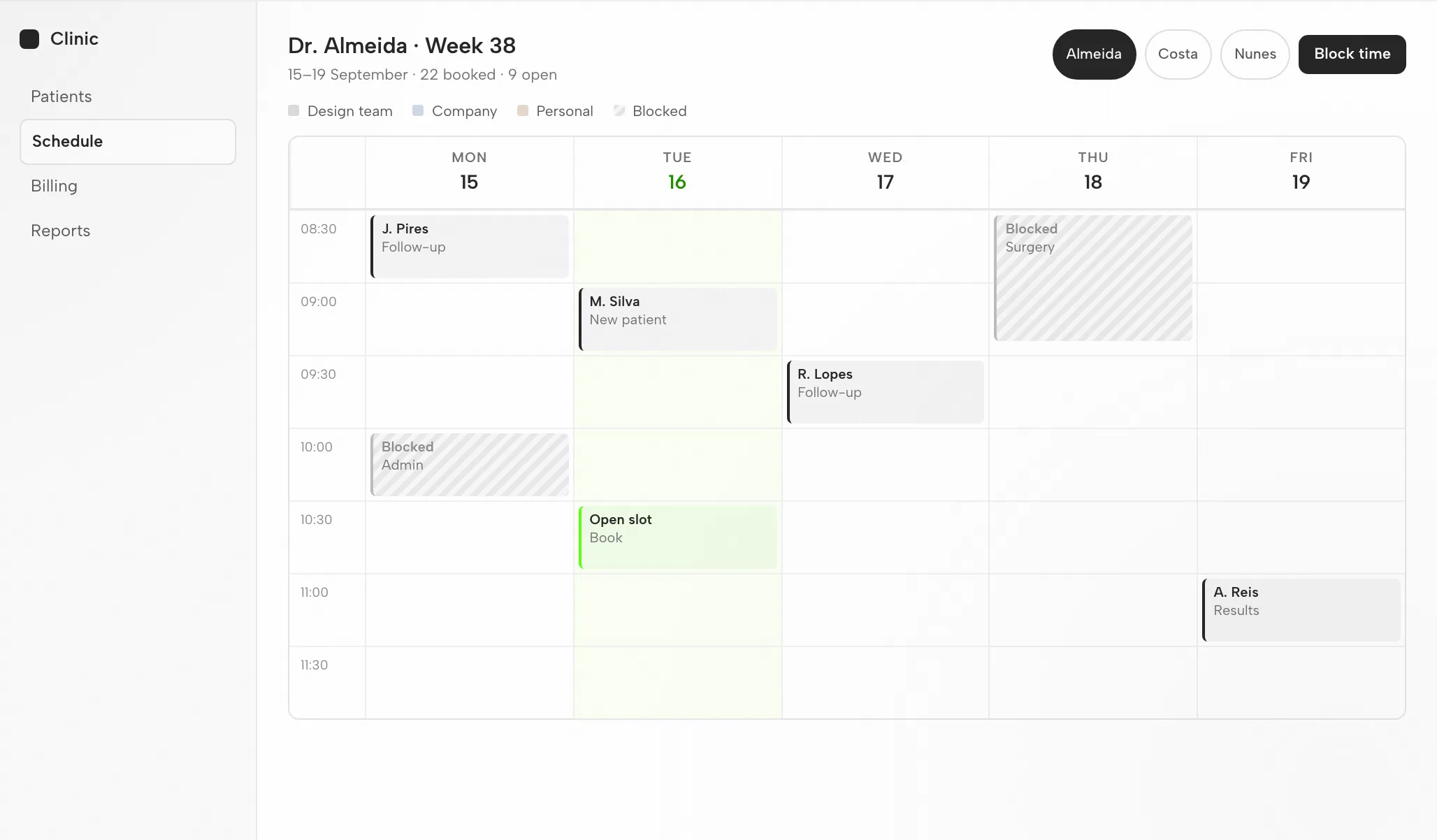
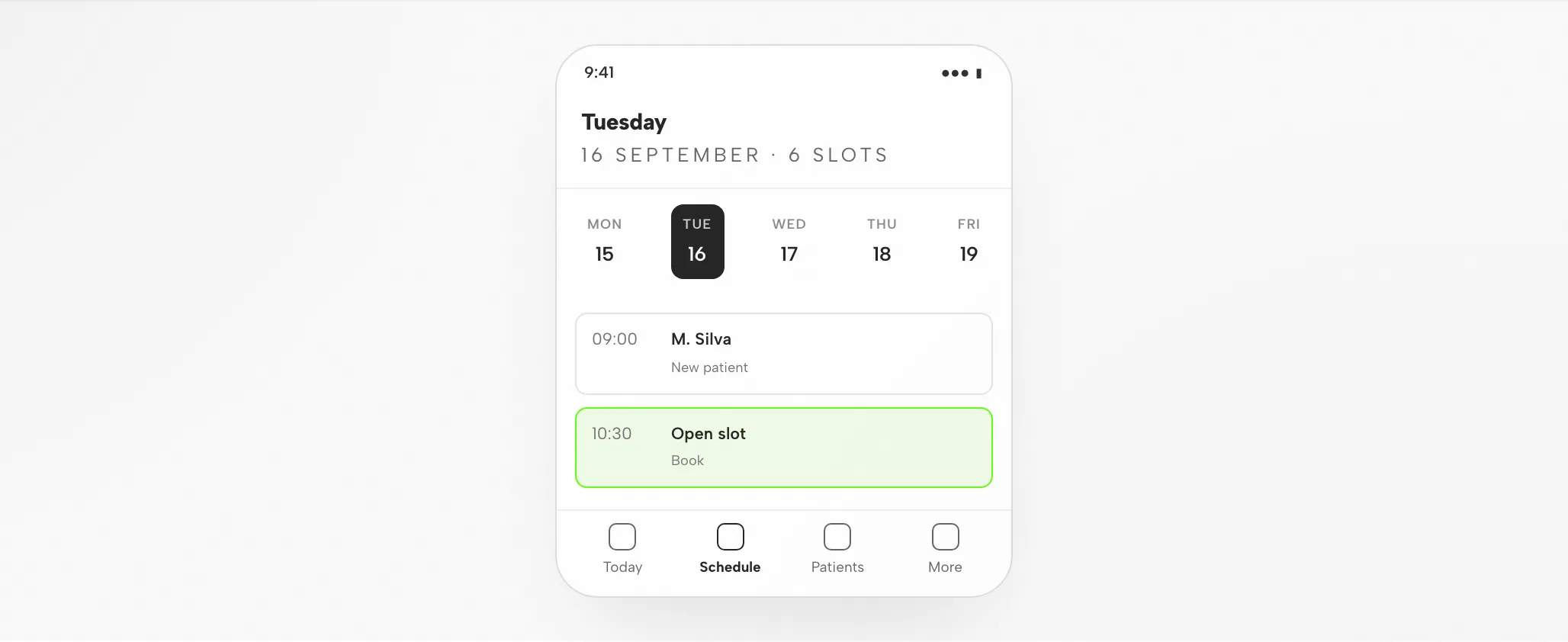
3Reasonix Artifact: The Booking Schedule at 1440px and 390px

Reasonix Artifact: The Booking Schedule at 1440px and 390px — Desktop
Illustrative example

4Review Before Handoff

Layout

Grid and Spacing

Half-hour rows on the 8px grid; blocked time reads as a hatched band, not as an event.

Hierarchy

Visual Hierarchy

Open slots read first for the receptionist; the accent marks open slots only.

Responsive

Mobile Layout

Day strip plus a slot list with book actions; practitioner switch at the top.

Interaction

Interaction Checks

Switch practitioner, open a slot, block an hour, move a day.

Fit

When Reasonix Fits the Task, and When It Does Not

Reasonix Fits When

  • Cheap, tight iteration. Built around DeepSeek's prefix cache, so the build-verify-refine loop stays affordable across long design sessions.
  • Repo-aware editing. Edits files directly in your repo with a review-gated editor, so it reuses your real components and tokens.
  • Skills + MCP. Markdown skills carry your conventions; MCP servers bring in design context like a Figma source as text.
  • Open and BYOK. MIT-licensed and open-source, running on DeepSeek models with your own DeepSeek API key.

Choose Another Workflow When

  • You need editable vector files. The artifact is HTML, not an editable design document. Check a separate vector workflow for your required asset format.
  • You have no reference and no constraints. Without a design system or examples the output tends toward a generic look; write the brief first.
  • You do not have the credential this agent needs. Required: Your own DeepSeek API key (bring your own key). OpenDesign does not provide or proxy credentials.
  • Your team works in DeepSeek or DeepSeek Harness. Those agents have their own pages; the workspace is the same, the setup differs. See related agents.

Compatibility

Reasonix Requirements Before You Start

This guide covers Reasonix as connected through the OpenDesign desktop app. Published references checked on 6 September 2026.

Tool ScopeReasonix, by Community / esengine

DeepSeek Reasonix is an open-source (MIT) terminal AI coding agent powered by DeepSeek models. It is community-built by the esengine GitHub author — not an official DeepSeek product — and engineered around DeepSeek's prefix cache so long sessions stay cheap. This page is about designing interfaces with Reasonix through OpenDesign, not about Reasonix’s own interface. OpenDesign’s setup notes list the available agents.

Accounts and AuthenticationYour own DeepSeek API key (BYOK)

Your own DeepSeek API key (BYOK). Authenticate with your own DeepSeek API key (BYOK) — credentials stay on your machine. This page does not promise a quota or price.

System and VersionsDesktop app or source

Check the download page for desktop builds. The Node.js and pnpm requirements in the source quickstart apply to running from source, not to installing a desktop package. Minimum compatible Reasonix version: not verified here.

Connection CheckThe success signal

Follow the connection instructions shown by your installed version, then run a small task. Confirm that Reasonix handled it and that the artifact opens. A download alone does not establish a working connection.

Start with the desktop app

Reasonix Setup in Three Steps

Download first, complete the Reasonix setup for your installed version, then check a small result. You do not need to build OpenDesign from source to follow this path.

  1. 1

    Download the OpenDesign Desktop App

    Choose the package for your computer, install it and open the app.

    Download OpenDesign
    CHECKPOINT
    The desktop app opens. Already installed? Move to the next step; there is no need to download again.
  2. 2

    Prepare Your Reasonix Connection

    Follow the Reasonix instructions in your installed version. Authenticate with your own DeepSeek API key (BYOK) — credentials stay on your machine.

    # 1. Install DeepSeek Reasonix (Node 22+) — see the repo README
    npm install -g reasonix
    
    # 2. Bring your own DeepSeek API key (BYOK)
    #    Reasonix reads it from your environment, not from config files.
    export DEEPSEEK_API_KEY=sk-...    # your DeepSeek key

    From the Reasonix setup notes in the published guide; check the vendor documentation for the current command.

    CHECKPOINT
    Confirm the intended agent and account. If it is unavailable, check compatibility before trying a larger task.
  3. 3

    Run One Small Reasonix Task

    Use a small brief so you can judge the whole loop, including one revision.

    Starter brief

    Build a settings screen with a profile form and a save confirmation. Use my design rules. Check it at desktop and mobile widths.

    CHECKPOINT
    Open the result, test the save state and request one specific change. A generated file is the beginning of review, not the end.

To run OpenDesign from source, follow the technical quickstart instead.

The Reasonix design workflow

The Reasonix Design Workflow in Five Steps

The same booking schedule task, followed from brief to verified file. Each step lists what you provide, what Reasonix does, what OpenDesign contributes and what you check.

  1. 1

    Design Brief

    Plain language, three to six lines. Name the audience, the job of the screen and the platforms.

    • YouWrite the brief; attach a reference screenshot if you have one.
    • ReasonixReads the brief and the project’s instruction file; asks when something is ambiguous.
    • OpenDesignProvides the project, the prompt surface and the skill for the artifact type.
    • CheckConfirm the brief states the acceptance criteria. Adding them now is cheaper than after generation.
  2. 2

    Design Constraints

    A design system and a few hard rules. This is what separates on-brand output from a generic look.

    • YouPick a design system; state breakpoints and any must-use components.
    • ReasonixLoads the DESIGN.md tokens and posture rules into context before writing a line.
    • OpenDesignShips the design-system library and binds the chosen one into the skill template.
    • CheckThe tokens match your brand. One accent, the right fonts, the right radius.
  3. 3

    Generate the Interface

    Reasonix writes a self-contained HTML file: layout, styles, interactions and stable hooks.

    • YouWait, or answer a clarifying question. Nothing to configure.
    • ReasonixPlans the sections, writes the HTML, CSS and JavaScript, runs the file and fixes what fails.
    • OpenDesignSaves the artifact into the project folder and indexes it for preview.
    • CheckNothing yet. Judge the file after it is rendered, not from the source.
  4. 4

    Preview

    The file renders inside OpenDesign at the widths you asked for. This is where the design is judged.

    • YouSwitch widths, click through the interactions, leave comments on elements.
    • ReasonixReads your comments on the preview and prepares the next revision.
    • OpenDesignRenders the preview, exposes data-od-id targets for comments and edits.
    • CheckHierarchy, contrast, overflow at 390px, focus states, and whether the accent is used sparingly.
  5. 5

    Revise and Verify

    Request changes by pointing at elements in the preview. Every revision is a new file; nothing is overwritten silently.

    • YouTurn comments into requests; decide when the task is done.
    • ReasonixApplies the changes in place and re-runs the file.
    • OpenDesignKeeps versions side by side; exports an image or the HTML when you are done.
    • CheckRe-check only the area that changed, then the whole page once at each breakpoint.

Resources

Reasonix Design Resources

Limitations

Reasonix Limitations, Manual Checks and Fallbacks

  • ScopeIt reads your codebase, edits files with a review-gated editor, runs commands, and supports Markdown skills and MCP. Its DeepSeek models (such as deepseek-v4-pro and deepseek-v4-flash) are text-only, so the design loop is reference-described and verified in a browser. This page covers Reasonix as an agent connected to OpenDesign, not every Reasonix feature.
  • Usage LimitsUsage limits and cost follow the credential you use (Your own DeepSeek API key). This page makes no claim about free quotas.
  • NetworkLocal project files do not mean offline inference. Review your agent’s provider settings and data policies before sharing sensitive inputs.
  • Output Is HTMLArtifacts are HTML files, not vector design files.
  • Manual ReviewAccessibility, real content, brand fit and interaction correctness are reviewed by you in the preview. Treat any self-check by the agent as a first pass.
  • FallbackIf the agent is unavailable or a task fails, check the installed version’s connection instructions and authentication. Preserve the error and the last working artifact before changing configuration.

FAQ

Common Questions About Reasonix and OpenDesign

Can DeepSeek Reasonix Really Do Design Work?
Yes — with an aesthetic skill, a design system, and precisely described references in context, DeepSeek Reasonix produces production-quality, responsive UI in your own repo, and you verify output in a real browser. Its DeepSeek models are text-only, so the loop is reference-described-and-verified rather than image-reading. Without that context it tends to default to a generic look, which is the gap OpenDesign fills.
Do I Need to Pay to Design With DeepSeek Reasonix?
You bring your own DeepSeek API key, so you pay DeepSeek for usage (BYOK) — but the agent is built around DeepSeek's prefix cache to keep that cost low across long sessions. Reasonix itself is free and MIT-licensed. OpenDesign never proxies your credentials.
Is DeepSeek Reasonix an Official DeepSeek Product?
No. DeepSeek Reasonix is a community-built, open-source project from the esengine GitHub author — it runs on DeepSeek's models and uses a DeepSeek API key, but it is not made or endorsed by DeepSeek the company. DeepSeek is a trademark of its respective owner.
DeepSeek Reasonix or Claude Code for Frontend Design?
Both can do real design work. Claude Code is known for specific, codebase-aware design decisions; DeepSeek Reasonix's edge is being open-source and cost-efficient, running cheap, high-volume iteration on DeepSeek models with your own key. Many teams use more than one — OpenDesign lets you switch agents without changing your design workflow.
How Do I Connect DeepSeek Reasonix to a Design Source Like Figma?
Reasonix supports MCP servers, so you can add a design-source MCP (such as a Figma MCP server) per the repo's docs. The agent can then pull real design context — components, variables, layout data — as text it can act on, so the generated code matches the source instead of approximating it.

Start a First Design Task With Reasonix

Start with a small task, judge the round trip, then bring the real brief. Choose the option that matches your setup; the page does not detect it.

Where are you in the setup?
Download OpenDesign See the setup checklist

OpenDesign Desktop

One design system. Every output unmistakably your brand

Inside the full Vibe Design Workspace, use the same brand rules across websites, slide decks, interactive prototypes, dashboards, images, and HTML video. Connect Codex, Claude Code, Cursor, and other coding agents already on your computer, then create locally for free.

  • Web, slides, prototypes, dashboards, images, and video
  • 140+ design systems, plus the full template and skill library
  • Connect local Codex and 21+ coding agents · Free to use
Download free

Available for macOS and Windows